1 The shop
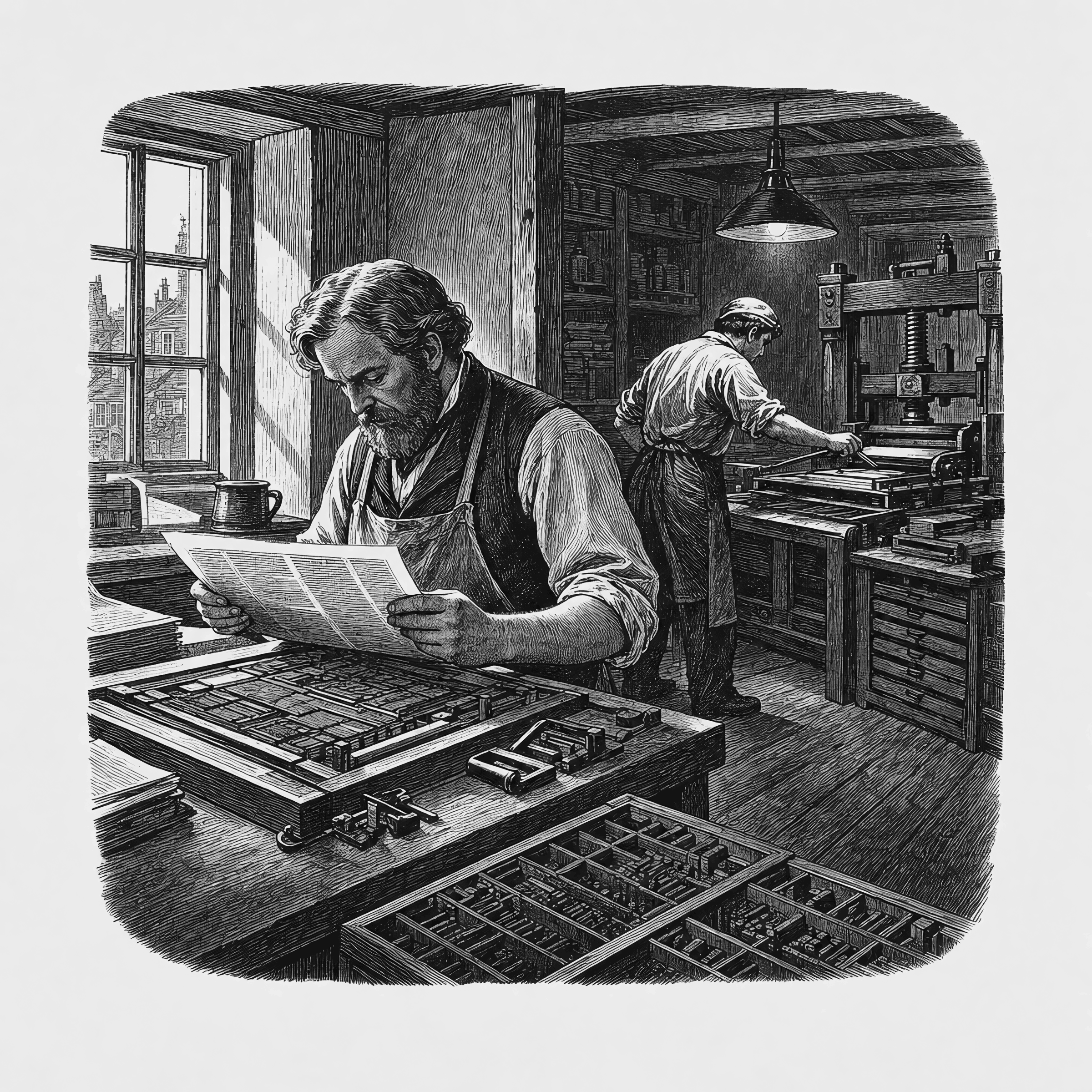
The old printing houses were built around one scarcity. Type went into the composing stick by hand, letter by letter, out of a divided case, and even a fast compositor got only a few columns from a long day at the frame. A shop that wanted more pages hired more fingers. The case room grew sideways, frame after frame. The reading closet stayed a closet, because one proof-reader with a boy to hold copy against him could keep pace with the whole floor. Setting was the slow part.
Then the composing machines came into the trade and the scarcity reversed. An operator at a keyboard set several times what a hand compositor set, and the machine did not slow in the afternoon. Setting turned cheap in a single generation. The choke point moved to the closet nobody had thought about, where proofs now stacked up faster than any reader could honestly work through them. Some houses noticed and rearranged themselves around reading. The rest went on shipping errors.
This book is a manual for a shop built after the reversal. It is a small shop. It is probably you and nobody else, or you and one or two partners, and it produces serious work: software people rely on, sometimes books. Everything in the chapters ahead follows from the arrangement described in this one.
Start with the machines. Several of them work here, and together they are the devil, whose chapter is coming. The devil is quick, tireless, willing, and not answerable. It works all night. It does what it is told, and it does things it was not told to do. Without its speed there is no shop, and nothing about the speed makes the work correct.
Hold on to one piece of arithmetic: the devil can set more type in an hour than you can read in a day. Practice will not close that gap, and next year’s devil widens it. So capacity, the thing every shop in history was starved for, is now cheap, and the scarce thing is authority: one person’s considered judgment, with a name attached, that this work should go out.
From that, the first law of the shop: nothing reaches a reader on capacity alone. Every path from the devil to the door passes through something with the standing to say no. Most of those gates are machines. The last one is you.
The devil takes everything whose correctness another machine can check. Save your reading hours for questions no gauge can settle. Whether the code compiles, whether the tests pass, whether the build reproduces, whether the output matches the specimen, whether yesterday’s behavior survived the night: machines answer all of those on every run, without you. Building the gates is itself much of the devil’s work, and it is good at it; a devil will happily forge the jig that catches its own errors. A check that takes four seconds can afford to run a thousand times a week.
You keep three things. Taste: whether the work should exist in this form at all, which no test can hold, because taste is a judgment about readers. Consequence: what happens to a particular person when this particular thing is wrong, and whether that price is yours to offer. And the signature. Old law required the printer’s name and address on everything that left the shop, so that someone could always be found and held to account. That statute has lapsed, but a customer with a broken install still wants a person, and the devil has no name a court or a customer can use. The name they get is yours, whether you print it or not.
The signature is also why the shop stays small. Machine-checkable work scales with the devil; take on as much of it as it can gate. Judgment does not scale. A jig can hold a gauge against ten thousand sheets, but the title page still has to be passed by a person, and the person is you. Each product, each audience, each promise no machine can vouch for adds one more spot on the floor that only you can occupy. Take on too many and you are running between the spots, glancing where you should be reading.
Here is the working day.
Morning is for reading. The devil worked the night, and the proofs are waiting: galleys of new work, corrected pages, reports from the overnight runs. Read the reports first. A clean report costs you ten seconds; a red one tells you where the morning goes. Then read the work itself. Whether it finished is the machine’s question, already answered. Yours is whether it is right, and whether it is good. Mark what needs another pass. Kill what deserves killing, without ceremony. Setting is cheap now, and the worst habit the old scarcity left us is reverence for work merely because it exists. A galley is not owed a place in the forme.
Afternoon is for setting new work, which mostly means writing copy. The devil sets what you give it, so give it copy worth setting: what to build, for whom, which parts must be exact, and framed so that a machine can check as much of it as possible. Phrase a requirement as a gate and you never have to read for it again; the hour spent making copy checkable comes back all week. Standing over the devil speeds nothing up, so hand the copy over and go do something else.
Evening is for pulling the run. Build everything, end to end, in the form a reader will receive it, and run every gate. Then open the finished artifact yourself: install the release, load the pages, the whole object, not just the diff. Most evenings this takes half an hour and tells you tomorrow’s reading will be routine. Some evenings it tells you the run does not go out. An unshipped run costs you one night. A shipped error has to be chased through doors you cannot see.
Then you stop and the devil does not; it is back at it by midnight. Let it run. Everything it sets tonight arrives tomorrow as proof, and proof is all it is until you have read it and signed. The chapters ahead take up the copy, the devil, the gates, the reading, and the pull, in the order the work moves through the shop.